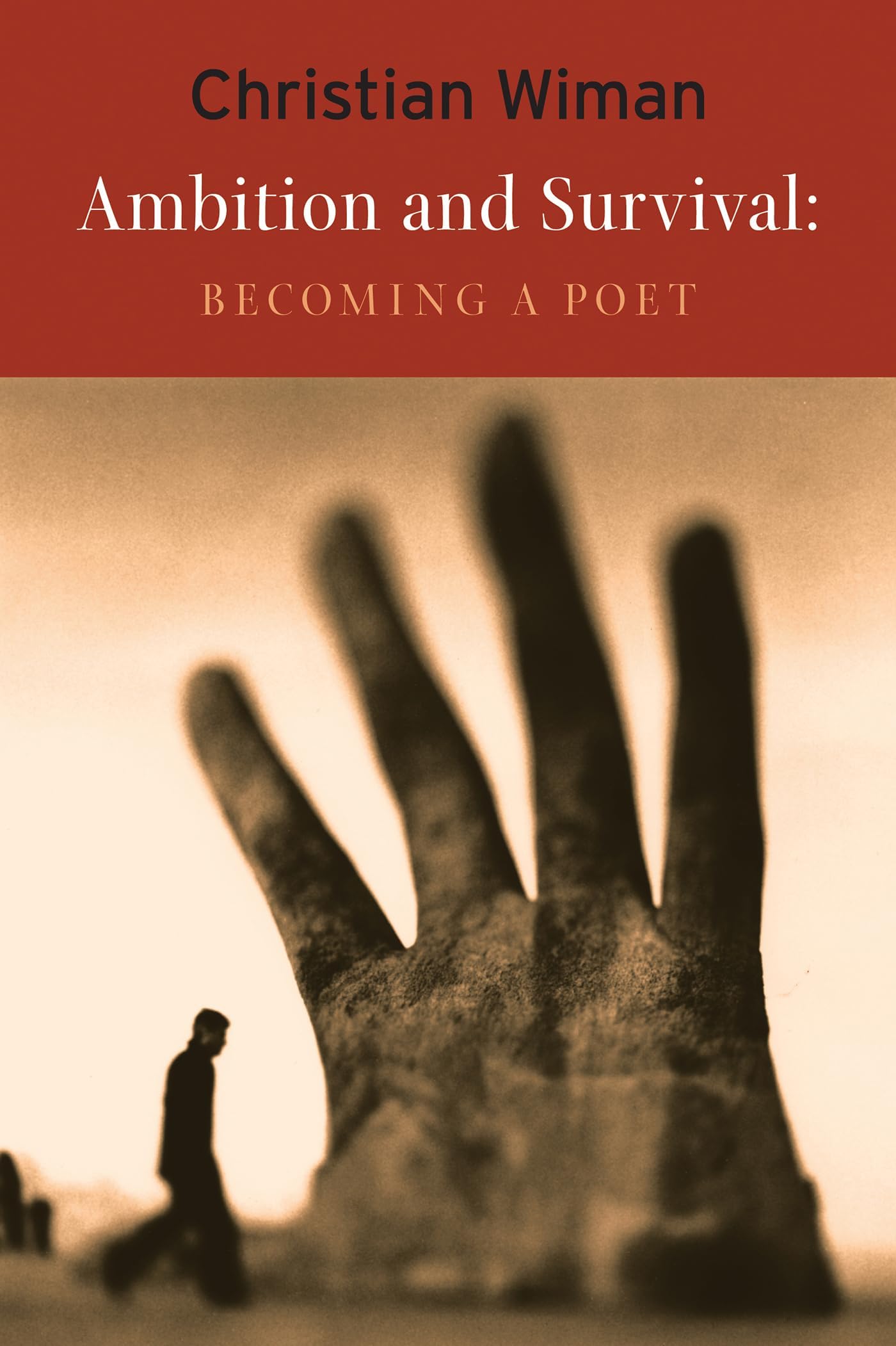
Ambition and Survival: Becoming a Poet
Product ID: 4082311
Buy anything from 5,000+ international stores. One checkout price. No surprise fees. Join 2M+ shoppers on Desertcart.
Desertcart purchases this item on your behalf and handles shipping, customs, and support to Grenada.
Blazing high style" is how The New York Times describes the prose of Christian Wiman, the young editor who transformed Poetry , the country's oldest literary magazine. Ambition and Survival is a collection of stirring personal essays and critical prose on a wide range of subjects: reading Milton in Guatemala, recalling violent episodes of his youth, and traveling in Africa with his eccentric father, as well as a series of penetrating essays on writers as diverse as Thomas Hardy and Janet Lewis. The book concludes with a portrait of Wiman's diagnosis of a rare form of incurable and lethal cancer, and how mortality reignited his religious passions. When I was twenty years old I set out to be a poet. That sounds like I was a sort of frigate raising anchor, and in a way I guess I was, though susceptible to the lightest of winds. . . . When I read Samuel Johnson's comment that any young man could compensate for his poor education by reading five hours a day for five years, that's exactly what I tried to do, practically setting a timer every afternoon to let me know when the little egg of my brain was boiled. It's a small miracle that I didn't take to wearing a cape. Praise for Ambition and Survival "That calling, at once religious, ethical, and aesthetic, is one that only a genuine poet can hearand very few poets can explain it as compellingly as Mr. Wiman does. That gift is what makes Ambition and Survival , not just one of the best books of poetry criticism in a generation, but a spiritual memoir of the first order." New York Sun "This weighty first prose collection should inspire wide attention, partly because of Wiman's current job, partly because of his astute insights and partly because he mixes poetry criticism with sometimes shocking memoir...The collection's greatest strength comes in general ruminations on the writing, reading and judging poetry." Publishers Weekly "[Wiman is] a terrific personal essayist, as this new collection illustrates, with the command and instincts of the popular memoirist ... This is a brave and bracing book." Booklist "Christian Wiman's poems often spoke of a void, and then they stopped. In Ambition and Survival, Poetry magazine's editor rediscovers his spirituality and his voice." Chicago Sun-Times Christian Wiman is the editor of Poetry magazine. His poems and essays appear regularly in The New Yorker , The Atlantic Monthly , Harper's , and The New York Times Book Review . He is the author of several books of poetry, including The Long Home (isbn 9781556592690) and Hard Night (isbn 9781556592201). Review: One of the best books ABOUT poetry that I have encountered - After reading "Once in the West" by Christian Wiman, I concluded that he is a poet worth reading more of and about. I turned to this, a collection of his essays. Ten of them are about poetry, there are about a dozen reviews of books of poetry, and there are six personal essays. The personal essays certainly belong, inasmuch as for Wiman poetry has been his life. Indeed, he begins the book as follows: "When I was twenty years old I set out to be a poet. That sounds like I was a sort of frigate raising anchor, and in a way I guess I was, though susceptible to the lightest of winds. * * * I still believe that a life in poetry demands absolutely everything -- including, it has turned out for me, the belief that a life in poetry demands absolutely everything." That speaks to the "ambition" of the book's title. The "survival" aspect takes on new urgency and poignancy in the last essay, in which Wiman discloses that he had recently been diagnosed with a rare incurable blood cancer. (That was nine years ago, and thankfully Wiman is still with us, teaching literature and religion at Yale Divinity School.) From 2003 to 2013 Wiman was editor of "Poetry" magazine. It can be safely assumed, then, that he is more knowledgeable about poetry than the average Joe. Most relevantly, he is much more knowledgeable about poetry than I am. Reading AMBITION AND SURVIVAL broadened and deepened my understanding of poetry and honed my "feel" for good poetry considerably. Two recurring points or themes stood out for me. One has to do with faith and belief. A poet, to be good, must have "faith in the mind's ability to find meaning in a world that exists independently of itself, and a concomitant faith in language to serve as a means of doing so." Perhaps, then, we should not be surprised to find that so much good poetry is suffused with religious faith and belief. The other theme relates to the importance of form in poetry. Personally, I much prefer poetry grounded in a formal structure of some sort. So, too, does Wiman ("I am more drawn to poetry of contained formal expressiveness * * * than to the sort of loose, discursive, anecdotal verse that has dominated contemporary poetry for decades"). In his essays, Wiman analyzes this preference and advances various reasons why poetry with at least a modicum of formal structure is more meaningful. To be sure, there were a few stretches of writing that bored me as well as passages that were beyond me. But they were fewer and farther between than was the case in the several other works of "poetry criticism" that I have sampled. And scattered throughout the book are observations worth noting, such as the following: * Irish Murdoch said "that there is no such thing as a bad poem because bad poetry simply wasn't poetry." (That is my attitude towards much of the schlock that's on the shelves of the poetry sections in many book stores.) * "It is the beauty of the world that makes us more conscious of death, not the consciousness of death that makes the world more beautiful." * "Great poetry is first of all sound. If a poet has no sense of cadence and form as expressions of feeling, then the limits of his or her accomplishment are quite small." Review: Setting High Standards for Poetry - At first I thought Wiman was being too tough on some poets, but then he is an accomplished poet in his own right, and some of what he says is refreshing to hear. I appreciate his honesty and believe much of it due to his facing a rare cancer and the restoration of his lost faith. He hits on some very profound subjects, such as the difference between imagination and memory. This is a book to be read slowly, and savored as you encounter lines like, "you know you're not in any real danger so long as what's happening to you still seems to be 'experience.'" He talks about how he needs "dead time" to write poetry and what the time between poems can be like. He concludes that we have to have the patience to wait and we have to know when not to write. He talks about how style should not become completely conscious and why. He says that poetry is lonely and how there are poems possible for us at only particular moments. He believes poetry is mysterious, and prose less mysterious, but also less rewarding. So how do poets survive the silent periods? He agrees with Wilbur that poets need to encounter chaos to write poetry. Read his essays on individual poets and poetry and on our visual culture. This is a book I will return to again and again because it is so thought-provoking. It will also make you want to read more of Wiman's own poetry.


| Best Sellers Rank | #1,035,600 in Books ( See Top 100 in Books ) #566 in Poetry Literary Criticism (Books) #1,929 in Essays (Books) #3,332 in Literary Criticism & Theory |
| Customer Reviews | 4.5 out of 5 stars 32 Reviews |
R**N
One of the best books ABOUT poetry that I have encountered
After reading "Once in the West" by Christian Wiman, I concluded that he is a poet worth reading more of and about. I turned to this, a collection of his essays. Ten of them are about poetry, there are about a dozen reviews of books of poetry, and there are six personal essays. The personal essays certainly belong, inasmuch as for Wiman poetry has been his life. Indeed, he begins the book as follows: "When I was twenty years old I set out to be a poet. That sounds like I was a sort of frigate raising anchor, and in a way I guess I was, though susceptible to the lightest of winds. * * * I still believe that a life in poetry demands absolutely everything -- including, it has turned out for me, the belief that a life in poetry demands absolutely everything." That speaks to the "ambition" of the book's title. The "survival" aspect takes on new urgency and poignancy in the last essay, in which Wiman discloses that he had recently been diagnosed with a rare incurable blood cancer. (That was nine years ago, and thankfully Wiman is still with us, teaching literature and religion at Yale Divinity School.) From 2003 to 2013 Wiman was editor of "Poetry" magazine. It can be safely assumed, then, that he is more knowledgeable about poetry than the average Joe. Most relevantly, he is much more knowledgeable about poetry than I am. Reading AMBITION AND SURVIVAL broadened and deepened my understanding of poetry and honed my "feel" for good poetry considerably. Two recurring points or themes stood out for me. One has to do with faith and belief. A poet, to be good, must have "faith in the mind's ability to find meaning in a world that exists independently of itself, and a concomitant faith in language to serve as a means of doing so." Perhaps, then, we should not be surprised to find that so much good poetry is suffused with religious faith and belief. The other theme relates to the importance of form in poetry. Personally, I much prefer poetry grounded in a formal structure of some sort. So, too, does Wiman ("I am more drawn to poetry of contained formal expressiveness * * * than to the sort of loose, discursive, anecdotal verse that has dominated contemporary poetry for decades"). In his essays, Wiman analyzes this preference and advances various reasons why poetry with at least a modicum of formal structure is more meaningful. To be sure, there were a few stretches of writing that bored me as well as passages that were beyond me. But they were fewer and farther between than was the case in the several other works of "poetry criticism" that I have sampled. And scattered throughout the book are observations worth noting, such as the following: * Irish Murdoch said "that there is no such thing as a bad poem because bad poetry simply wasn't poetry." (That is my attitude towards much of the schlock that's on the shelves of the poetry sections in many book stores.) * "It is the beauty of the world that makes us more conscious of death, not the consciousness of death that makes the world more beautiful." * "Great poetry is first of all sound. If a poet has no sense of cadence and form as expressions of feeling, then the limits of his or her accomplishment are quite small."
M**N
Setting High Standards for Poetry
At first I thought Wiman was being too tough on some poets, but then he is an accomplished poet in his own right, and some of what he says is refreshing to hear. I appreciate his honesty and believe much of it due to his facing a rare cancer and the restoration of his lost faith. He hits on some very profound subjects, such as the difference between imagination and memory. This is a book to be read slowly, and savored as you encounter lines like, "you know you're not in any real danger so long as what's happening to you still seems to be 'experience.'" He talks about how he needs "dead time" to write poetry and what the time between poems can be like. He concludes that we have to have the patience to wait and we have to know when not to write. He talks about how style should not become completely conscious and why. He says that poetry is lonely and how there are poems possible for us at only particular moments. He believes poetry is mysterious, and prose less mysterious, but also less rewarding. So how do poets survive the silent periods? He agrees with Wilbur that poets need to encounter chaos to write poetry. Read his essays on individual poets and poetry and on our visual culture. This is a book I will return to again and again because it is so thought-provoking. It will also make you want to read more of Wiman's own poetry.
T**S
Sometimes tedious, sometimes insightful with a deeply moving final chapter
As a poet and instructor of poetry writing, I was hoping for a book that spoke to me, inspired me, as so many books I've read about poetry have. But the entire first half of the book (mostly written 15-20 years ago) dragged, and it seemed to me that Wiman was speaking more from an academic intellect than a more whole and deeper self. But in the last few chapters, I found some words of wisdom - and the final chapter was not only beautifully written, it was also deeply moving. So I have a mixed reaction to the book. With most books about poetry, I take 3-5 pages of notes. I was 2/3 of the way through this book before I wrote down a word. But then I filled up two pages. The beginning of the book is about Wiman's own life - mildly interesting, but forgettable. In much of the middle section, he discusses individual poets. Unless you have read these poets (I was quite familiar with Millay, Eliot and Walcott and only a few of the others), the pages about them may not hold your interest. I only read the first sentence of each paragraph about some of them. The power of the last chapter for me was in the lyricism of Wiman's prose as related to his rediscovery of faith and connection to his spiritual self. My guess is that his style and tone throughout most of the book would have been different if he had started it in 2005-2006, which is when he wrote the last chapter. I give 5 stars to the last chapter, but really only 3 1/2 to the rest of the book.
A**X
What It Takes to be a Poet
Ambition and Survival: Becoming a Poet By Christian Wiman Are you someone who aspires to be a poet, or a poet who wants to grow in your craft? Then you might consider Christian Wiman's Ambition and Survival. It's not easy reading; in fact it can be downright discouraging in places. Don't get me wrong, Wiman is brilliant, his writing is elegant, and his use of humor is well-placed. His standards are stupendous, and oh yes, I must say, he's arrogant. You could say he has cause. He's editor of Poetry Magazine, a publication that has grown mightily under his direction and with the help of a two million dollar grant. Many knowing people claim this magazine publishes the best poetry of our time. Wiman seems to be saying that the greats have their time, but it passes and their work degenerates. Virtually none escapes his judgment, except perhaps Emily Dickinson. He's most fond of Thomas Hardy, which pleases me because Hardy didn't start writing poetry until he was sixty. His praise of Hardy is that he is clear, wise and balanced. On top of it, he's other-centered. Wiman lumps one of my favorites, William Carlos Williams, in with him, for the same reasons. I've been hard on Wiman, in a way, but he has my utmost respect, partially because he himself has suffered and overcome a bizarre and difficult background. It's all explained in the book. I give it my highest recommendation and urge you to take it slowly. Allan Cox, author of "WHOA! Are They Glad You're In Their Lives?" to be published June 5, 2012
M**L
Full of discoveries
I began to read this in a library copy, but found so many things I wanted to highlight that I bought the Kindle version. There are patches of great storytelling - his trip to South America in particular; a number of reviews of poets' books (some of the poets I don't know at all) and his incisive and insightful comments about their work; and the final chapter on his return to Christianity, his marriage and the discovery of cancer - all within a year. Now that I have a Kindle version I'll go back and read sections again. Some of the book isn't easy to grasp in one reading, especially the loose compilations of brief thoughts (many of which take no more than a longish paragraph), but for understandings of poetry and its recent history, the book is great. The wonder to me is how he has such a breadth of knowledge about poets and what a vast amount of reading he must have done in his relatively short lifetime.
D**G
Dense
I love Wiman's works but I found this and one other to be densely written and packed, so much so that it was hard work to read and re-read, but in the end it was a good journey.
V**R
and he's very funny. I found myself laughing out loud more than ...
I have been reading this book slowly, over the last year, in part because there is so much of value on every page, in part because I wasn't sure what I would do when I finished it. All my life, I've bee reading prose books by poets about poetry, but I have often found the writing too self-conscious and labored. Wiman's prose is clear, thoughtful, surprising, illuminating. He doesn't shy away from his own opinions, and he's very funny. I found myself laughing out loud more than once. But the greatest gift I've received is a reawakening of the impulse to take literature seriously. Fine books are one of our surest paths into what matters, and we should read them and think about them and write about them, regardless of how small the audience or how tepid the applause. I knew this once, but I forgot it. Wiman has reminded me in the most convincing way.
W**Y
Thought provoking....
Christian Wiman is a very insightful writer. I bought this book after reading another essay of his entitled "Hive of Nerves" subtitled: To be alive spiritually is to feel the ultimate anxiety of existence within the trivial anxieties of everyday life. This book was no disappointment with each essay bringing in a time of reflection. I surely recommend this book to anyone who wants to have their way of thinking challenged.
Trustpilot
2 weeks ago
2 weeks ago