Buy anything from 5,000+ international stores. One checkout price. No surprise fees. Join 2M+ shoppers on Desertcart.
Desertcart purchases this item on your behalf and handles shipping, customs, and support to Grenada.
📸 Zoom into the wild with confidence and clarity!
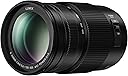
The Panasonic LUMIX G II Vario 100-300mm lens is a splashproof, dustproof telephoto zoom designed for Micro Four Thirds mirrorless cameras. Featuring a bright aperture range (F4.0-5.6), Power O.I.S. with Dual I.S. 2.0 stabilization, and a fast 240 fps linear motor for autofocus, it delivers sharp, stable images from wildlife to sports photography. Its compact, rugged design and superior build quality make it a top choice for professionals and enthusiasts seeking versatile reach without bulk.


| ASIN | B01N0U4BY2 |
| Best Sellers Rank | #163 in Mirrorless Camera Lenses |
| Brand | Panasonic |
| Built-In Media | Lens cap, Lens hood, Lens rear cap, Lens storage bag, lens |
| Camera Lens | 300 month |
| Camera Lens Description | 300 month |
| Color | Black |
| Compatible Camera Models | Panasonic LUMIX G series |
| Compatible Camera Mount | Micro Four Thirds |
| Compatible Devices | Panasonic DMC-GX1, Olympus OM-D E-M10 Mark III, Panasonic DC-GX9, Olympus E-M10 Mark IV, Panasonic DMC-GX85, Panasonic DMC-G6KK, Panasonic DMC-GF7KK, Olympus E-M1, Panasonic DC-GX9 Refurbished, Panasonic DMC-G7, Panasonic DC-GH5 Refurbished, Panasonic DMC-GX85 Refurbished, Olympus E-PM2, Olympus E-PL1, Olympus E-PL3, Panasonic DMC-GX8, Panasonic DC-GX850, Olympus OM-D E-M1X, Olympus OM-D E-M5 Mark… |
| Compatible Mountings | Micro Four Thirds |
| Customer Reviews | 4.6 out of 5 stars 329 Reviews |
| Exposure Control Type | Automatic |
| Focal Length Description | 100-300 millimeters |
| Focus Type | Auto Focus |
| Global Trade Identification Number | 00885170310964 |
| Has Self-Timer | No |
| Image stabilization | Optical |
| Iso Range | 200-25600 |
| Item Weight | 0.01 Ounces |
| Lens | Telephoto |
| Lens Coating Description | Nano surface coating |
| Lens Design | Zoom |
| Lens Fixed Focal Length | 300 Millimeters |
| Lens Mount | Micro Four Thirds |
| Lens Type | Telephoto |
| Light Sensitivity | 200-25600 |
| Manufacturer | Panasonic |
| Manufacturer Part Number | H-FSA100300 |
| Maximum Aperture | 5.6 f |
| Maximum Focal Length | 300 Millimeters |
| Media Type | VisualMedia |
| Minimum Aperture | 5.6 f |
| Minimum Focal Length | 100 |
| Model Name | H-FSA100300 |
| Model Number | H-FSA100300 |
| Number of Diaphragm Blades | 7 |
| Photo Filter Size | 67 Millimeters |
| Real Angle Of View | 12 Degrees |
| UPC | 885170310964 |
| Unit Count | 1.0 Count |
| Video Capture Resolution | 4K (3840 x 2160) |
| Warranty Description | No Warranty |
| Water Resistance Level | Water Resistant |
| Zoom Ratio | 3:1 |
A**E
Gateway lens into wildlife photography
Thinking of getting into wildlife photography? Can’t decide between this lens or the OM/Olympus 75-300mm lens? Read on and maybe this review will help you. I have been shooting with Micro Four Thirds since 2015. I have tried other format and brands over the years as well. I have owned 3 different Olympus 75-300mm lenses and 2 Panasonic 100-300mm lenses. As of right now, I only have the Panasonic 100-300mm lens. Comparing the 2 lenses: The Olympus lens is lighter and slightly smaller in size than the Panasonic lens. When you factor in the lens hood, they are similar in size. The Olympus lens starts at a wider Focal Length of 75mm vs Panasonic 100mm. The Olympus lens has a shorter minimum focal distance. The Panasonic has a brighter aperture of f5.6 at 300mm vs f6.7 on the Olympus. The Panasonic comes with a lens hood and the Olympus does not. The build quality feels better on the Panasonic and I like the rubber grip on the zoom ring. The Olympus lens feels like a cheap kit lens. The Panasonic has Optical Image Stabilization while the Olympus does not. The Panasonic is "Splash proof / Dustproof" while the Olympus is not. Auto Focus performance: If you’re using a capable camera body such as the OM-1, both lenses will perform about the same. The Panasonic lens AF performance will better on Panasonic bodies. When I used the Olympus lens on the Panasonic G9II I was very disappointed with the AF. The Panasonic 100-300mm AF performance was much better. But on my OM-1 Mark I camera, I don’t notice any difference between the 2 lens AF. Honestly in order to fully get the most of theses lenses for wildlife photography, you should use high-end camera bodies. Sharpness between the 2 lenses: Flip a coin! As I stated before, I have own several copies of both lenses and there’s no clear winner. One lens may be a little sharper but it’s more due to sample variation, so you better hope you’re lucky and get a sharp lens! Now, keep in the mind the cost of these lens. They are not going to be as sharp as more expensive lenses. But I feel the sharpness is fine for size and reach you get from these 2 lenses. I’ve included a crop image of a test chart that is at 100% zoom in so you judge for yourself. The image was taken with the Panasonic lens on my OM-1 at 300mm at F5.6. I found both lens sharpness is best around F7.1 to F8. So should you get the Olympus or Panasonic lens? Well it really depends on your needs. I mostly own OM lens and this is the only Panasonic lens I have. I sold my OM 75-300mm lens as I found this lens is better for my needs. This lens pair with my OM-1 is my compact & take any where wildlife setup. I love this setup and the images it can produce. When you're ready to step-up, then look at the Panasonic 100-400mm or OM 100-400mm lens. I have the OM 100-400mm and it's a better lens overall and my preferred setup. But as I stated, I won't sell this Panasonic lens due to the size, reach, and wonderful images I can get from this lens.
D**R
A good lens with optical image stabilization.
The lens offers wonderful optics and light performance, is reasonably priced, and is easy to carry. It produces images with good quality and features optical image stabilization.
J**N
It's a learning process but worth the money
I have had this lens for over a month and let me start by saying this, you will not find a better telephoto in this price range with the quality of this one. With that being said, you will not get sharp images right out of the box, allow me to explain. Most negative reviews on this product are due to user error. YOU HAVE TO TREAT THIS LENS LIKE A 600MM. Tips -USE A HIGH SHUTTER SPEED! 1/640 ( depending on your system) or more. -Practice, practice, practice. -Be patient, there is a strong learning curve Pros -Lightweight -Sharp images when used correctly -Excellent image stabilization -Weather sealed -Solid Build Quality Cons -Iffy low light performance -Autofocus tends to hunt a lot ( Biggest drawback in my opinion) -There is a learning curve -Not the fastest lens out there -Softer images at the long end Overall, if you're looking to start wildlife, sport, etc photography without breaking the bank, this is hands down your best bet for lenses. Keep practicing and you'll eventually master this thing!
A**Y
Essential for distance shots
Have had this for a while now with 0 issues. Does exactly what it's supposed to do and provides a clear image at long distances. Musician photographed from the far back of the show.
G**O
Great lens that stands out among its peers. Just be aware of some minor quality issues.
Plenty sharp, even with the aperture wide open. Not as sharp as more expensive lenses with long focal lengths, but doesn't need to be. Focuses very well on my Olympus and Panasonic cameras. Smooth mechanical operation and magnificent image stabilization, especially with cameras supporting Panasonic's Dual IS. Weather-sealing seals the deal for me. So why not five stars? Because zoomed in toward 300mm, the optics are slightly decentered, which usually introduces softness at the right edge of the frame. Research tells me this is a common problem with the 100-300mm lens, including version 1 (which means Panasonic has had a long time to improve quality, but hasn't done so). Also, the focus ring has a really cheap feel to it, compared with all the other lenses I own. These problems are acceptable for me, but could be serious enough for some users to make them want to either try many copies of the lens or go with an alternative.
J**N
Great lense and impressive image stabilization
I've been very satisfied with this lense. The image stabilization is exceptional. I'm able to take reasonable quality photos of the moon at 300mm holding the camera in my hands. Since its a 100-300mm micro 4/3, it's not a great all around lense. It's rare that I'm not swapping lenses often as even at 100mm, the field of view is narrow. If you want a quality lense for those long shots, this is a great choice. If looking for an all round lense, or to carry a single lense for that next vacation, the zoom on this one may be too much with a narrow field.
G**F
Big results for little price
I don't think there is a better bang for the buck lens out there for the G line of cameras. The image stabilization of this lens rivals that of my canon 100-300 and still has a very good picture for video all the way out to 300. It may not perform the best in low light but it gets the job done and doesn't break the bank. The zoom is a little tight to start with but has softened up after use to look smooth enough for video. it feels a little lens heavy on the body so make sure you have a steady tripod for video and the gorilla pod won't be very steady for zoom work. The lens shade is perfect sized and you can still use the lens caps without taking off the shade. Update jan 2018....This lens has produced some of the best long range animal footage I could have hoped for in such a small and light format. The video is crisp, clean and clear and auto focus works really fast. It produces great bokeh and the stabilization is on par or better than my big canon lenses. Totally impressed.
H**D
High Quality Lens
10/10 for any photographer that uses Panasonic camera. Setup and ease of use is perfect. Zoom range is phenomenal. Weight is great. Functionality is perfect for that amazing picture. I use it for photographing nature and animals. Everyone loves the photos I take!
R**D
Must have for MFT cameras
Great sharp lens that is small enough to throw in a bag and not worry about the weight. With the focal range of 600mm equivalent for the price, it’s a definite win.
P**W
Value for money
Bought it during special discount.
M**E
Tolles Objektiv
Ein super gutes Objektiv! Ich würde es wieder kaufen.
T**N
Teleobiettivo estremo alla portata di tutti
Quando fotografavo a pellicola, sono sempre stato negato nell'uso dei teleobiettivi. Scattando a 100 iso, senza stabilizzatore, sia con il 200mm che con il 300, a mano libera (ottiche poco luminose, altrimenti avrei dovuto accendere un mutuo e comprare un furgone solo per i teleobiettivi), le mie foto erano sempre affette da micromosso, o da una leggera sfocatura, anche scattando con tempi, teoricamente, di sicurezza. Da quando sono entrato, dopo anni di letargo, nel sistema Micro 4/3 Lumix, mi si è aperto un mondo tutto nuovo e meraviglioso. Dopo aver preso la mano col 45-150, che equivale ad un 90-300 nel pieno formato, non ho resistito, e ho ordinato il Lumix Vario 100-300 II f/4-5.6 Avere un 600 mm f/5.6 era un sogno proibito da sempre. Il fattore di crop, o di moltiplicazione, degli obiettivi micro 4/3 è di 2x, quindi questo obiettivo equivale a dei cannoni giganteschi nel formato pieno o anche in Aps-c. Qui abbiamo un obiettivo delle dimensioni di una lattina di coca cola, che sta quasi in tasca, e questo è il primo, enorme vantaggio. Il secondo vantaggio è il prezzo: con 600 euro o poco più, ci si porta a casa un 200-600 equivalente, dalla luminosità nemmeno scandalosa. Esiste uno Zuiko 75-300 e costa anche un po' meno, ma a 300 mm è un f/6.7, cioè quasi uno stop in meno, e non è stabilizzato! Il terzo, enorme vantaggio, si chiama Power O.I.S. : questo obiettivo è dotato del sisrema di stabilizzazione interna più evoluto di casa Panasonic. Esiste una versione precedente, dotata di Mega O.I.S. Meglio prendere questa, la versione II, molto più efficace. Montato sulla mia G90, ho una doppia stabilizzazione ottica! Infatti sono riuscito finalmente a scattare a 600 mm, foto che mai avrei pensato di poter fare. La resa ottica di questa lente non è la più tagliente dell'universo, ma si difende bene. Sinceramente, la nitidezza delle foto, mi è sembrata più che valida, anche a tutta apertura. Per le esigenze di un fotoamatore, non mi posso lamentare. Anche la velocità di messa a fuoco è più che sifficiente. Non sono un fotografo sportivo, uso questo obiettivo per fotografare animaletti e persone. Inserendo il tracking sulla mia G90, sono riuscito a seguire i germani in acqua anche quando passavano dietro le foglie, senza che la macchina perdesse il fuoco (merito della macchina) e con una risposta dell'obiettivo sempre molto veloce. Non so se si comporterà in modo valido anche con soggetti più veloci, ma per ora sono soddisfatto. L'obiettivo è realizzato interamente in policarbonato. Non ha giochi e le ghiere scorrono in modo fluido. La ghiera dello zoom è rivestita in gomma. C'è un interruttore sul barilotto per escludere lo stabilizzatore. Non ne comprendo appieno l'utilità, dato che è facile operare direttamente dal corpo macchina, almeno sulla G90, ma penso lo abbiano inserito per risparmiare batteria, e per corpi macchina in cui occorre accedere al menù per comandare la stabilizzazione, con maggiore perdita di tempo. In dotazione c'è un paraluce con innesto a baionetta e una custodia morbida. Ho ordinato questo obiettivo da Amazon UK perché su Amazon EU è quasi sempre esaurito. Esperienza tragica. Dopo il brexit, ordinare da UK è diventato un calvario. Prima di riceverlo ho dovuto fornire a Ups altri dati aggiuntivi, fotocopie dei documenti ecc. E il tracking non è stato quasi mai aggiornato. Se potete, prendetelo da amazon EU, costa anche qualcosa in meno.
C**N
Telefoto 300mm
Buen lente para tomas de lejos y si no le importa que sea algo oscuro las tomas a 300mm pero lo uso en una cámara de video así que todo va bien
Trustpilot
2 weeks ago
2 weeks ago