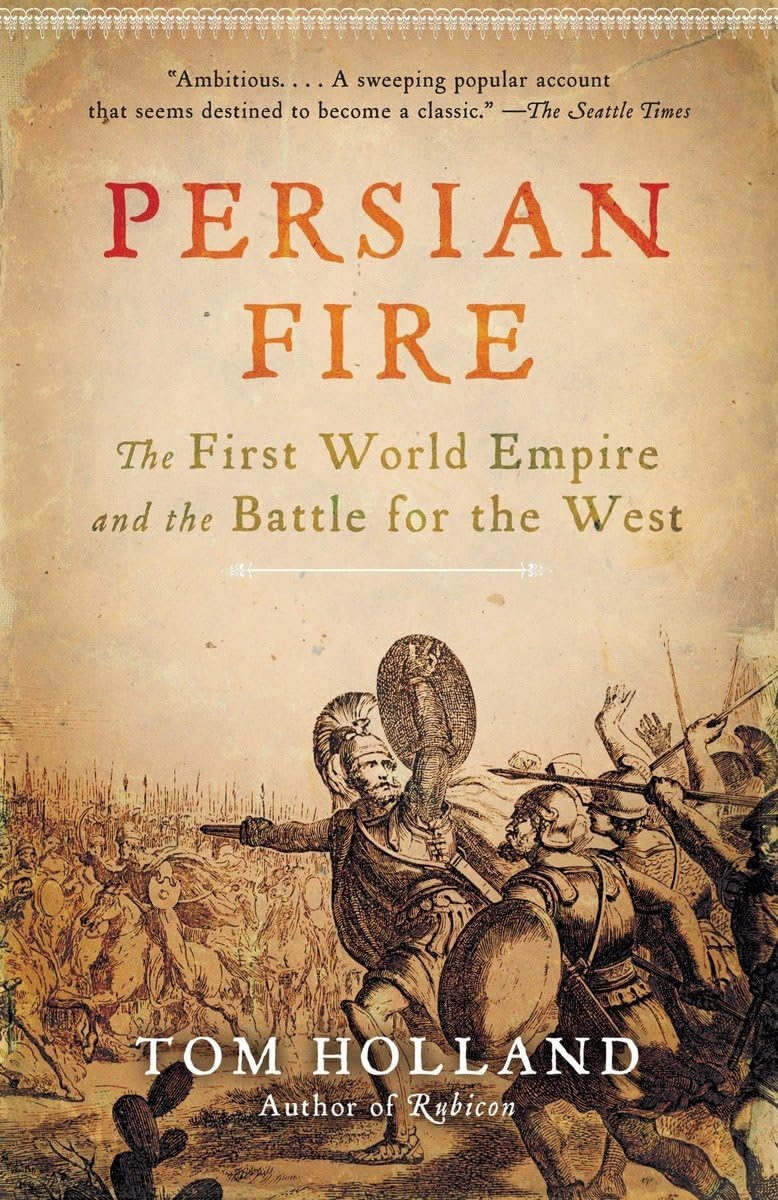
Persian Fire: The First World Empire and the Battle for the West
Product ID: 1706089
Buy anything from 5,000+ international stores. One checkout price. No surprise fees. Join 2M+ shoppers on Desertcart.
Desertcart purchases this item on your behalf and handles shipping, customs, and support to Grenada.
A “sweeping popular account” ( The Seattle Times ) of how Athens and Sparta withstood an assault from the Persian Empire in the cradle of Western civilization, from the acclaimed author of Rubicon and co-host of the hit podcast The Rest Is History “Excellent. . . . There is an even handedness in Holland’s treatment of both Greek and Persian cultural riches that is rare in popular accounts of these wars.” — The Sunday Times (London) In the fifth century B.C., a global superpower was determined to bring truth and order to what it regarded as two terrorist states. The superpower was Persia, incomparably rich in ambition, gold, and men. The terrorist states were Athens and Sparta, eccentric cities in a poor and mountainous backwater: Greece. The story of how their citizens took on the Great King of Persia, and thereby saved not only themselves but Western civilization as well, is as heart-stopping and fateful as any episode in history. Tom Holland’s brilliant study of these critical Persian Wars skillfully examines a conflict of critical importance to both ancient and modern history. Review: Holland is Strong - Holland's book is the most enticing account on Marathon. I have five other histories on the battle, ranging from a title by a military scholar to recent popular entries and Holland is superior across the board. He still hits the same points of argument all histories do since Herodotus but I am hunting down a Folio Society edition for the bookshelf because Holland's style is exemplary and I plan to reread it in the years to come. That is rare for me. Holland's talent reminds me of Arthur Schlesinger. What a talented writer and tremendous book. Review: History made fun - Once again, Holland produces another exciting and readable history of the ancient world. This book covers the period of the early 400s BC, although it provides useful background on the Persian empire, Sparta, and Athens. While Holland rightly claims the battle was crucial in preserving Western civilization, he does try to allow the reader into the Persian mind. His introduction highlights the Persian empire's multi-ethnic nature and superpower status, making it somewhat analogous to America (as opposed to the chauvinistic, petty Greeks). One of the things Holland does well is use modern terms to describe ancient politics, making them more accessible to the modern reader. For example, in the introduction he describes the Greeks, from the Persian point of view, as terrorist states. He also accepts that the protagonists on both sides held certain religious/philosophical beliefs that cannot be left out of the narrative. For example, he incorporates the Gods into his story when it is clear Greek soldiers viewed the Gods as a source of woe or fortune. A cautionary note: if you tend to be bored by history, this book is not for you. Some of the other reviewers complained about the abundance of names and dates. However, this is necessary as Holland has a complicated story to tell spanning decades. On the other hand, if you are curious about history but bored by standard history textbooks or more academic pieces, this is a good, readable synthesis of the history. I should also caution that I am only a casual student of history, so I cannot verify that all of the facts in the book are true. Holland probably could not either since records of history during this time are so sketchy anyway. There is legitimate debate over other historical facts. Even if one or two tiny details are historically debatable (and so far as I can tell they are not), this book will hopefully educate more readers about the ancient world and an important war that shaped Western civilization.

| Best Sellers Rank | #29,241 in Books ( See Top 100 in Books ) #7 in Ancient Greek History (Books) #9 in Iran History #26 in History of Civilization & Culture |
| Customer Reviews | 4.5 out of 5 stars 2,045 Reviews |
P**R
Holland is Strong
Holland's book is the most enticing account on Marathon. I have five other histories on the battle, ranging from a title by a military scholar to recent popular entries and Holland is superior across the board. He still hits the same points of argument all histories do since Herodotus but I am hunting down a Folio Society edition for the bookshelf because Holland's style is exemplary and I plan to reread it in the years to come. That is rare for me. Holland's talent reminds me of Arthur Schlesinger. What a talented writer and tremendous book.
A**D
History made fun
Once again, Holland produces another exciting and readable history of the ancient world. This book covers the period of the early 400s BC, although it provides useful background on the Persian empire, Sparta, and Athens. While Holland rightly claims the battle was crucial in preserving Western civilization, he does try to allow the reader into the Persian mind. His introduction highlights the Persian empire's multi-ethnic nature and superpower status, making it somewhat analogous to America (as opposed to the chauvinistic, petty Greeks). One of the things Holland does well is use modern terms to describe ancient politics, making them more accessible to the modern reader. For example, in the introduction he describes the Greeks, from the Persian point of view, as terrorist states. He also accepts that the protagonists on both sides held certain religious/philosophical beliefs that cannot be left out of the narrative. For example, he incorporates the Gods into his story when it is clear Greek soldiers viewed the Gods as a source of woe or fortune. A cautionary note: if you tend to be bored by history, this book is not for you. Some of the other reviewers complained about the abundance of names and dates. However, this is necessary as Holland has a complicated story to tell spanning decades. On the other hand, if you are curious about history but bored by standard history textbooks or more academic pieces, this is a good, readable synthesis of the history. I should also caution that I am only a casual student of history, so I cannot verify that all of the facts in the book are true. Holland probably could not either since records of history during this time are so sketchy anyway. There is legitimate debate over other historical facts. Even if one or two tiny details are historically debatable (and so far as I can tell they are not), this book will hopefully educate more readers about the ancient world and an important war that shaped Western civilization.
S**O
Though a poor example of popular history, it covers the subject
A word of warning to readers of fiction who want to try popular history: This is not a good sample. Even as an experienced reader of history, I had to occasionally slow down and repeat a sentence to comprehend it. Why? PERSIAN FIRE has an overabundance of long awkwardly constructed sentences. And it is verbose. I understand that ancient history presents a problem. Because source materials are scant, how can an author fill up enough pages to make a publishable book? Still, I prefer a short book that is to the point, over a long one with decorative words that clutter the mind. Unfortunately I cannot recommend something that is easier to read and equally informative of the subject. But if you can sift through Tom Holland's ostentatious prose, you will take home some shiny baubles. The three main characters are not persons, they are states: Persia, Sparta, and Athens, chronicled from birth to maturity. From the white horses and Great King Xerxes of Persia, to the polished shields and King Leonides of Sparta, to Themistocles and the democratic people of Athens--this is a variegated, fleshed-out epic. You have probably already heard at least a little about two of this story's legendary fields of play: Marathon and Thermopylae. Now Mr. Holland can invigorate you with the details. For extras, he provides an ample selection of photos, plenty of footnotes, and a long bibliography. His maps are tight with the text, though for quick reference you may want to paperclip the page with the "List of Maps." This can be a rewarding book for the determined reader. But unless you are specifically interested in the Greco-Persian wars, popular history is better exemplified by other works. I mean works that are easier to read. You could try something by David McCullough, Robert K. Massie, or Barbara W. Tuchman. Less reputable but even easier to read are works by John Toland, Stephen E. Ambrose, and Diana Preston. PERSIAN FIRE proves that a good subject is not enough for five stars, which I would have awarded if the style had been simpler and more humble.
W**Y
A wonderful, meandering history
No one puts together disparate pieces of an academic history into life quite as well as Tom Holland. Like all of his efforts, Persian Fire delivers with a view of the Greco-Persian War that, if not NEVER told, definitely deserves more air. Disdaining the oft bewailed lack of Persian sources, Holland brings together the story of an impossibly vast, impossibly ancient sea of cultures stretching from the Aegean to the Indus. The Achemenids are only the latest in a series of giants that stretch all the way back to and even into prehistory. The Greeks, by contrast, are every bit the squalid backwater the Persians disdained: backbiting, oath breaking, bizarrely nationalist over the small picture and disdainful of the large. Indeed, that's the one ambivalence I felt about the narrative. The stands at Thermopylae and Marathon, the Battle of Salamis are all held up as great events in a cultural division of East and West, monumental in the birth of what a conservative view of history might call "Western Civilization." And yet...is it? Holland is great at leaving the question just short of begged. Clearly the loss of Xerxes did nothing in particular to advance Greek unity or Athenian intellect immediately; as Holland points out the Parthenon was constructed more as a show of one upmanship to Sparta in the run up to the Peloponnesian War, and then Philip/Alexander, and then...what? Holland never lays it right out but leaves a tantalizing view of Greco Roman history as a reconstruction of later people desperate for an ur-validation, much as he described the compilations of the hadith in In the Shadow of the Sword. And if Darius came up with the first proto holy war, if echoes of Zoroastrianism wound down through the millennia to Christianity and Islam, if the "East" delivered the first strong centralized states...was there even an East? Is there? Hints, and nudges and the occasional wink, and in conclusion that is the final delight to this history.
A**R
easy to read
I was looking for an easy read for the greco persian wars, and this certainly was it. I struggled with herodotus, but this like a simpler version. So I can highly recommend it!
M**L
Unmatched storytelling.
A story almost too big and impactful to fit within these few pages. Holland has accomplished something truly remarkable here. Each of the many historical and mythological characters comes to vibrant life, and for the combatants - often a crushing flesh and bones death. Hubris, nemesis, bitter infighting among allies, fearless bravery and courage in the face of certain annihilation, Spartan pride, Athenian arrogance, spy-craft, political scandals, bribery, deceitful murder and the ultimate sacrifice of willingly giving up your life for your family, your comrades and your country. It is all here. All faithfully re-told by Holland. One of the most accessible, engaging and unforgettable accounts of the Persian-Greek wars. I could not recommend it more highly. Truly a masterful effort!
S**G
A good book on the conflict, not not the best out there.
In "Persian Fire", author Tom Holland recounts the conflict between the great empire of Persia and the Greek world that a great many would argue changed world history and could have altered world history in ways we couldn't even imagine had the Persians prevailed. The author "sets the stage" with a history of the Medo-Persians who came down from the mountains and uplands of what is today Iran and Turkey to defeat the Assyrians and conquer the "known world". So, with the defeat of the Egyptians, the Persian empire stretched from India to Africa. Holland recounts revolt of the Ionian cities which brought the Persians into conflict with the Greeks and served as the impetus for the Persian invasion of Europe. This book is very much centered on the Persian perspective, chronicling the ascendancy of first the Medes and then the Persians. He looks at Zoroastrianism and it's influence on the thinking of Persian monarchs. The book essentially follows the Persians and their expansion which inevitable brought them into Europe. In other ways, it's well-plowed ground, recounting the battles between the Persians and the Greeks beginning with the first invasion under Darius which ended at Marathon and expanding with the campaign commanded by Xerxes with highlights at Thermopylae, the sea battles off Artemesium and Salamis as well as the final act at Plataea where the Persian threat ended. It's a good retelling of the History of the conflict - especially if you want more from the Persian perspective and with more of their history. I admit if given a choice, I'd recommend Thermopylae: The Battle For The West by Ernle Bradford who writes more from the Greek point of view as well as being written in a more engaging style even including some wry humor here and there. Once again, a good book from the Persian POV, but well-plowed ground that's been done before and a little better. Four stars.
J**N
2,500 year old conflict continues
it's hard to tell if this is about events of 2,500 years ago....or the present!!!! Holland frames the conflict of east vs west in a way that the past looks into our future
B**T
Great information, easy to read.
Any fan of Ancient History and avid reader will enjoy it.
W**I
Persian Fire, Fury and Failure
How did a relatively small band of Greeks halt the expansion of the mighty Persian empire and, subsequently, change the history of the western world forever? This is the question to ponder on whilst you read this fascinating work. Firstly, a quick note on the author, Holland has a brilliant knack for disseminating the classical past in an engaging way. From his descriptions of the brutal schooling of the Spartans, the fiercest warriors of Greece, to his portrayals of the political manipulation of Themistocles in the Athenian ecclesia – his beautiful prose makes for swift reading of complex procedures. Speaking as a history student, the past is not always as straightforward as we would like it to be. However, writers like Holland showcase classical history at its best by exercising scepticism alongside true representations of the myths, as they were supposed to be told, to give wonderfully coherent accounts. For the first half of the book, Holland focuses on the origins of the Persian Empire, Athens and Sparta to assign a context to the battle for the west. Initially, Holland portrays the Medes as an insignificant, nomadic tribe on the fringes of established civilisation and then traces their rise to pre-eminence to the point of Eastern domination. The Persian story, both mystical and cynical, places the Great King in a semi-divine light with the purpose of annihilating the Lie in the name of Ahura Mazda, the omnipotent Persian god, and therefore gives the Great King an ideological, and undoubtedly pragmatic, motive for expansion. This background proves vital in setting the scene for the resulting conflicts and for luring the reader away from simplistic Greek perceptions of the Persians as effeminate, “trousered barbarians”. The chapters on the development of Athens and Sparta demonstrate to the reader that the war was not just a matter of the Greeks versus the Persians. Classical Greece was, in fact, a very diverse place and the polis (city-state) next door could be a completely alien world; as a result, ‘Greekness’ was not fixed or defined. Holland reinforces this point with exemplary style as he handles the narrative of the precarious beginnings of Athenian democracy, whilst stage-managing the multitude historical actors, with ease and contrasts this with the austere and rustic development of Sparta. It soon becomes apparent throughout Persian Fire that the war was, perhaps, more about vested interests and demagoguery than it was about liberty or Hellenistic fervour. Holland is in his element when describing the intense battle scenes towards the end of the book. The author creates vivid pictures in the imagination of disciplined Spartans taking comfort in their witticisms in the face of imminent death at Thermopylae. In addition to this the grim portrayals of the battle at Marathon, as a small Greek force first locked swords – or triremes – with the Persian invader, make for fascinating reading. However, the anticipation for these moments and the rich context provided are what make them truly satisfying to read. However, with the positives aside, the reader should be prepared to find this work a challenging read. The study is obviously very well researched and can leave the reader feeling a tad overwhelmed at times. Anglicised versions of Greek names are not the easiest to read for someone in the infancy of their interest in the Greek world. But, as with all great works, if the reader perseveres and grasps the rudiments of the narrative they will be rewarded and will, most likely, build their vocabulary alongside enjoying a sensational story of the clash between east and west. Eloquent and erudite, articulate and assiduous; Holland brings the classical past to life with sober judgment and novelistic flair. I would recommend this novel to anyone with an interest in classical Greece, but be prepared to find it challenging due to the prodigious amount of detail provided.
I**O
Great!
Great narrative History. A delight.
H**A
A Unique Perspective on the Medic Wars
Tom Holland Does it again. A unique perspective on a history on which so much was written. As usual, Tom Holland begins at the source by allocating a section to each of the three main protagonists of the Medic Wars: Athens, Sparta, and the Persian empire. All three sections evolve toward the main events of the two Medic Wars which are covered in the latter part of the book. You don't only end up knowing what happened during the Medic Wars and how they happened but why the events happened as almost a natural conclusion of the evolution of the three players toward the conflagrations. Tom Holland is an exceptional historian and he proved it again in this book.
A**A
A Must Read
The books about the Persian Greece wars. Brilliantly written. Makes not just the wars but also the politics of Athens and Peloponnisi come alive. Very readable. Highly recommended.
Trustpilot
1 week ago
2 months ago