We remain fully operational. Our teams are working around the clock to ensure your deliveries continue safely.

DOWNLOAD THE APP


Customer Services
Copyright © 2025 Desertcart Holdings Limited
DOWNLOAD THE APP

🌌 Unlock the universe from your backyard — see what others only dream of!
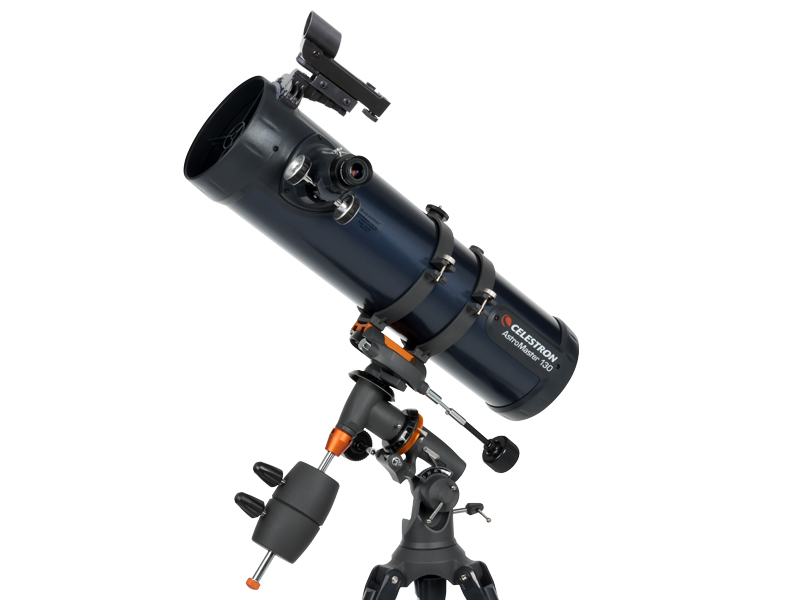
The Celestron AstroMaster 130EQ is a beginner-optimized Newtonian reflector telescope featuring a 130mm aluminized primary mirror with SiO₂ coatings for enhanced brightness and contrast. Its German equatorial mount with slow-motion control knobs allows precise manual tracking of celestial objects. Quick, tool-free assembly and an adjustable tripod provide stable, comfortable viewing for all users. The package includes essential accessories like 20mm and 10mm eyepieces, a StarPointer red dot finderscope, and a free download of the Starry Night astronomy software. Weighing 17 lbs, it balances portability with robust construction, supported by a 2-year US warranty and dedicated customer support, making it an ideal gateway for millennials eager to join the stargazing community.


| ASIN | B000MLL6RS |
| Additional Features | German Equatorial Mount with Slow-Motion Control Knobs, Permanently Mounted StarPointer, TheSkyX - First Light Edition Astronomy Software |
| Best Sellers Rank | #210 in Camera & Photo Products ( See Top 100 in Camera & Photo Products ) #2 in Telescope Reflectors |
| Brand | Celestron |
| Built-In Media | 20mm eyepiece with built-in erect image corrector, Optical tube, Red-dot finderscope, Standard 10mm eyepiece, Tripod and mount (preassembled) |
| Coating | Glass mirrors coated with aluminum and SiO₂ |
| Compatible Devices | iPhone, iPad, Android devices |
| Customer Reviews | 4.3 out of 5 stars 3,398 Reviews |
| Dawes Limit | 0.89 Arc Sec |
| Exit Pupil Diameter | 1.44 Millimeters |
| Eye Piece Lens Description | Standard 10mm eyepiece |
| Field Of View | 0.67 Degrees |
| Finderscope | Built-on StarPointer™ red dot finderscope |
| Focal Length Description | 650 millimeters |
| Focus Type | Manual Focus |
| Global Trade Identification Number | 00050234310451 |
| Item Dimensions D x W x H | 38"D x 38"W x 56"H |
| Item Weight | 17 Pounds |
| Manufacturer | Celestron Acquisition LLC |
| Manufacturer Part Number | 31045 |
| Model Name | AstroMaster 130EQ |
| Model Number | 31045 |
| Mount | Equatorial Mount |
| Number of Batteries | 1 Lithium Metal batteries required. (included) |
| Objective Lens Diameter | 130 Millimeters |
| Optical Tube Length | 552 Millimeters |
| Optical-Tube Length | 552 Millimeters |
| Power Source | Not Battery Powered |
| Telescope Mount Description | Equatorial Mount |
| UPC | 050234310451 |
| Unit Count | 1.0 Count |
| Warranty Description | TWO-YEAR LIMITED WARRANTY |
| Zoom Ratio | 90 multiplier x |
C**R
Great telescope to get beginner interested in hobby
So there's been a lot of discussion in the reviews about if this is a beginner telescope or not. As a person who never touched a telescope (except maybe in high school a thousand years ago) until I decided it was something I wanted to try out this year, I emphatically say YES! This is a great beginner scope. Here's the problem with most people's definition of a "beginner" anything. They want it to be rock-bottom priced, and ultra-easy to use. The problem with this mentality, is that often you go so cheap that you wind up getting a product that does not really expose you to the prospective hobby, and while trying to find something ultra-easy to use, it winds up being extremely difficult because it lacks the more expensive tools that were specifically designed to enhance the human ability when performing certain tasks.... NET RESULT: You wind up putting the hobby down out of frustration without ever really trying it out. I think the reality with getting into telescoping (is that a word?) is that you have to first decide that it is something you truly want to try, so that you don't go by a $74 telescope at W*****t (like I did) and expect to actually be introduced to this hobby. So after trying the $74 failure I got this scope due to the (mostly) good reviews, and because of the brand name. Never being in the hobby myself, I still had heard of Celestron. Many reviews showed broken parts. This wasn't the case for me. Everything was intact and assembly was relatively easy for a novice. A few reviews said this was not a beginner telescope because you had to adjust the mirrors, which apparently was a very difficult task to do. I researched this requirement ahead of time, found that for just over $20 you can buy a laser collimator that allows you to do this adjustment in just a few minutes, and decided that wasn't too much to ask to have an opportunity to enjoy this hobby. P.S. when I got the telescope, I used the laser collimator just to find out that the mirrors were perfectly aligned and I didn't need to do any adjusting. But apparently mirror adjusting is inevitable with Newtonian telescopes, so I'll just keep the laser collimator in my kit bag. Now about the beginner using this scope: 1. The red dot starfinder is a life saver! At first I thought you could just look through the starfinder, see what you wanted to look at, then see it in the telescope. NOPE! You really need that red dot to put the object into the site picture of the scope (especially on a low MM eyepiece). My only complaint might be that I couldn't perfectly adjust the red dot. When I first got the scope I focused in on a house way down the street, then tried to calibrate the red dot so that it was pefectly centered on the center of what I saw in the eyepiece... It was close, but wasn't perfect. HOWEVER. It is more than sufficient for my beginning level telescoping. With my $74 flunkee scope, I would use the cross hairs to try to align the scope to an object, yet even on a large MM eyepiece I could never find anything smaller than the moon! With this red dot starfinder, I have (easily) been able to align the telescope to both Jupiter and Saturn. 2. I may have started of with the starfinder, but the equitorial mount is probably the show winner with this thing. Not to keep referring to my $74 fail, but it is good to have a frame of reference when explaining why sometimes you have to make an investment even for entry-level equipment into a hobby. The $74 fail used a super cheap camera tripod. Problem with these tripods is they don't adjust at a fine enough level to make the small changes to put an object into the site picture. And, despite the fact that the cheap scope didn't weigh anything, it still would drift on the tripod... basically making it impossible to do anything except look at the moon. The Celestron is big and heavy, yet the EQ mount holds it masterfully in position, but the real winner is the fine tuning knobs. I didn't realize just how fast objects move in space (I mean.. I get it. The earth is spinning at 1000 mph, I just never put that together to mean objects move out of a telescope site picture QUICKLY). But with one hand on the fine tuning knob, I can follow the object for a reasonable amount of time to enjoy viewing it. NOTE: I recently bought a motor that I am suppposed to be able to connect to the knob, so that it can automatically hold the picture for me (again... spending more to get the right tools to enjoy the new hobby). Only complaint I have is that one knob seems to be able to adjust indefinitely while the other can only change maybe 20 degrees (10 in each direction) before it hits a stop. After additional study, I think this is because space objects only move in one direction, so if you properly polar align the scope, you should only need one knob to get the object where you want (left and right) and then not touch that again, then solely use the (up and down) knob to follow the object as it moves in the sky... but hey.. I'm new.. I'll learn to use this better too :-) Other than that, the only thing left is the scope. Like I said, I've looked at Jupiter, Saturn, Moon. I can't really speak to the provided eyepieces. Understanding from my research about focal length, and deciding that as a beginner it would help if I had an adjustable eyepiece (so that I can start zoomed out, find the object easier, then zoom in), so I bypassed the provided eyepiece and went straight to a x2 barrow with an 8-24mm adjustable eyepiece. So far it's been great! Saturn is still a little small, so I'm going to see if I can go even smaller on MM and higher on barrow zoom to see if I can really clearly make out the rings. ....but do you see what Celestron did? They created a (relatively) affordable telescope that grabbed my interest in the hobby and now I am full on exploring new ways (EQ mount motors, higher zoom barrow, lower MM eyepieces) that I can explore the universe above!
D**.
Excellent astronomic equipment and good price
Already I have had opportunity to do a few tests of this telescope and can comment to them that the image is excellent. The construction and the design is robust enough. Only I found two negative details of design. First the screw that is used for adjustment of this latitude evil designed. When one increases the latitude due to the weight of the this assembly it becomes hard to manipulate and when one tries to diminish the latitude, that is to say to slacken the screw in order that the set goes down, the plastic piece separates of the metallic screw turning out to be very inconvinient to do that the assembly goes down almost to the point of remaining united. I come second, the unions of the tripod of stainless steel to the assembly are plastic, these should be metallurgies to give him better permanence in the time. A recommendation for CELESTRON, they must improve the protection of the packing of the Mount CG3, it(he) is not alone to put it in a box without any protection, this one should come protected by rubber(gum), to avoid what happened to me, that in the sending(parcel) and due to the weight of the mount, the mount I strike and there was doubled the screw of Slow Movement in DEC. Lamentably I cannot do claim for guarantee since I am in Venezuela, and the costs of movement going and return of the equipment(team) they be be very high in comparison with the cost of the Telescope. I do not still have mas remedy that to try to repair the piece. David Trujillo P. Barquisimeto, Edo. Lara Venezuela Español. Ya he tenido oportunidad de hacer unas pruebas de este telescopio y les puedo comentar que la imagen es excelente. La construcción y el diseño es bastante robusta. Solo encontré dos detalles negativos de diseño. Primero el tornillo que se usa para ajuste de latitud esta mal diseñado. Cuando uno incrementa la latitud debido al peso del montaje este se torna duro para manipular y cuando uno intenta disminuir la latitud, es decir aflojar el tornillo para que el conjunto baje, la pieza plástica se separa del tornillo metálico resultando muy incomodo hacer que el montaje baje casi al punto de quedarse trabado. Segundo, las uniones del trípode de acero inoxidable al montaje son plásticas, estas deberían ser metálicas para darle mejor durabilidad en el tiempo. Una recomendación para CELESTRON, deben mejorar la proteccion del empaque de la Montura CG3, no es solo ponerlo en una caja sin ninguna protección, este debería venir protegido por goma, para evitar lo que me pasó, que en el envío y debido al peso de la montura, la montura se golpeo y se dobló el tornillo de Movimiento Lento en DEC. Lamentablemente no puedo hacer reclamo por garantía ya que me encuentro en Venezuela, y los costos de traslado ida y vuelta del equipo serían muy altos en comparación con el costo del Telescopio. No me queda mas remedio que tratar de reparar la pieza. David Trujillo P. Barquisimeto, Edo. Lara Venezuela
A**R
This was an excellent purchase. This was my second purchase ever in ...
This was an excellent purchase. This was my second purchase ever in Astronomy. It has a clean look, gives crisp views and not terribly priced for a beginner scope. CON's: NOT FOR ASTROPHOTOGRAPHY! I thought I had researched allot about what I wanted in my telescope, but I was wrong. I could not in any reviews where it was stated that astrophotogaphy with this telescope was going to be possible. So, I figured I'd be the one to warn. Please don't misunderstand, this is an outstanding scope for the money. Modifications need to be done to the scope in order to bring a subject into focus. I have read everything from cutting off a portion of the tube, removing a portion of the focus tube allowing for more in-focus (please take a look through Cloudy Nights-a forum for astrophotography) and modifying the mirrors position in the telescope. It can be done, so don't be discouraged if this is the scope you absolutely want. The star finder is not a star finder either. The reviews in here which denote that piece of equipment as a pain, well, agreed. What I have learned is that the telescope mount is absolutely key. I purchased the RA motor mount that goes with this setup, and it will not help you much. In order for the image to reach the DSLR chip, you have to use a barlow lens which increases the focul length, and proportionately, the difficulty in tracking DSOs. The better the tracking and shorter the focul length, the longer you can expose for. The longer duration exposure allows for more photons to reach your DSLR chip, and finally rendering you a nice image of nebula's, galaxies, etc. The mount is pretty sturdy despite some of the reviews here, with slight modification. I only extend the legs approximately half way or less out. This decreases the number of seconds required to allow the mount to steady itself before taking photos, or even achieving focus. The RA motor allows you to increase and decrease tracking speed. I have not found a perfect setting just yet. I have only been able to capture .3 second frames, which is just enough to capture a tiny glimpse of nebula and only the brightest stars. Out of frustration, I mounted my $70 Celestron PowerSeeker 70mm refractor to the mount and was able to achieve a maximum of 6 second subs before star trails appeared. This was while I framed it in BackyardEOS, and also while i was constantly adjusting the speed to keep Orion Nebula in place. I have attached two photos, one with the Astromaster and one with the PowerSeeker. The refractor is not better quality than the Astromaster, the mount is just better able to keep the lighter refractor on point just a fraction longer. When I had done my research, I could not find any photos from this setup, so I will attach one from the PowerSeeker. I was unable to render a useable photo utilizing the Astromaster 130. I intend on purchasing the Celestron AVX mount with the Astromaster 130. It is a much more accurate mount. Visually. this is an awesome scope. Jupiter, moon, viewing Orion Nebula, it's wonderful. Conclusion, this is a wonderful scope and mount for viewing the heavens, not for astrophotography.
E**L
"Big Bang" for your astronomy buck
Let me say right from the start that you must set up some parameters or boundaries to work within when shopping and comparing performance, features, etc. When I was shopping around I kept asking myself what if a spend a little more, over and over. By the end of my browsing session I'm seriously considering a 16" light bridge truss dobsonian. So here's the highlights. 1. Looks. I think you'll be hard pressed to find anything in this price range that looks more the part. I really like the orange annodized alum. bits & pieces. They really pop against the metallic blue optical tube. To me this thing looks like more scope than it really is. 2. Apeture. 130mm is about as big as you'll find at this price point. Apeture is everything. The more the merrier. Do not get caught up in the magnification hype that is very common in department store telescopes. As a matter of fact this scope does not have very high power as supplied. With it's reletively short focal length, you'll need a barlow lens to get some big mag. numbers. 3. Mount. Since I come from a cheap department store scope background, this is the best mount I've owned. Now that said, it is still very light, and there are plastic bits on the telescoping legs that will break if you get over assertive when tightening fittings. To a serious amature astronomer this thing is probably shakier than a Chihuahua at the north pole. The tripod probably is the weakest link in the package. THe legs are steel, but of the shower curtain rod wieght, not electrical conduit weight. It's probably the best place for them to skimp, in my opinion. There are tricks to make a mount more stable, but most of us don't want to grind our own optics at home. If you keep your hands off the scope while observing, it's more than stable enough for some good viewing. It will take some time for it to settle down after focusing, but that's what we have to deal whith at this price point. 4. Optics. They seem pretty good. I get sharp points when viewing stars. I've found nebulae for myself for the first time with this scope. It's small and light enough to grab and go, which is how I use it so far. The viewfinder is on the weak side. It's a red dot finder with no magnification. That's not the bad part. It's that they used plastic lenses that definately eat some of the light passing through, and also seem to illuminate a slight bit when the red dot is on. Combined with the positions you may have to contort yourself in when viewing objects near azimuth, it's my least liked feature on this scope. 5. Overall you get good apeture and optics for the money, it's nice enough looking to leave set up in a corner. You get an equatorial mount that can be motor upgraded cheaply. I'm happy with my purchase, and I've since spent more money on eye pieces and accesories than I originally spent on the scope itself.
S**L
awesome telescope but will need time to learn how to use properly
OKay so this EQ mount was easy to put together but it takes some time to get used to this style of mount but read the instructions or some videos on youtube and you'll be set! This telescope is great for viewing the moon and some planets like Jupiter and Saturn! They will still appear small but you will see Saturn's rings and Jupiter's moons. I haven't been able to see any deep space objects due to light pollution but over all not a bad telescope! Again... this may take time to learn how to balance and use this EQ mount properly and you will need to take the time to learn how to use it right and once you do its amazing! I don't recommend this for astrophotography as its not really set up for it BUT if you can get yourself an adapter for your mirrorless cameras then it does a great job! The image i captured is straight from my Sony A6400 and it was not stacked so its just one single image, not bad but with some more time and patience you'll be able to get even better pictures, but again this telescope isn't made for astrophotography.
T**E
Worth the extra cost over the Powerseeker 127EQ
Tried the Powerseeker 127EQ first and was only acceptable. Then I bought the Astromaster 130EQ and found it to be a fine quality sharp image excellent Reflector Telescope. You should be prepared to learn a bunch before feeling accustomed to this Reflector but you will be rewarded for your efforts. A laser collimator is a must to check, and if necessary, realign the mirrors, known as Collimating. I spent some time learning how to collimate this Scope, or align the mirrors and I devised an additional step in the beginning as I am a former technical writer. First, making sure the laser Collimator is NOT in the focuser tube and is definitely OFF, stand a few feet in front of the opening or aperture of the telescope and look into the opening where you will see the cross frame in front, the mirror in the back, and the reflection of the front cross frame in the back mirror. Then slowly and carefully concentrate on what you see and move your view slowly so the mirror and reflection of the cross frame appear centered within each other and the telescope tube. The point is to confirm that the main mirror is perpendicular to the axis of the tube such that all parts viewed appear to be all centered or concentric with each other. If looking straight down the tube center, you see the reflection of the secondary mirror frame up front off center and offset from the actual frame up front, then carefully adjust the primary mirror in back so everything looks aligned. That means the back mirror reflection of the front cross frame should be aligned behind the frame when looking absolutely down the center of the tube and the mirrors appear correctly centered. After you have assured a nearly aligned primary mirror when viewed from the front, then you can proceed to install the laser collimator into the eyepiece focuser with the indicator target pointing forward as the telescope does. Turn on the laser and DO NOT LOOK into the front of the telescope until you are done and the laser is out and OFF. Slowly adjust the secondary mirror up front carefully and slowly loosening and tightening very delicately each of the three screws until the laser dot is centered on the target. Remember to very delicately loosen and tighten the screws slowly and in steps between the three until you become accustomed to how the adjustments affect the laser dot on the target. Once you have centered the dot on the target adjusting the secondary mirror up front, then TURN OFF the laser and rotate the laser Collimator in the focuser tube such that the target opening is facing the back of the Telescope where the primary mirror is. Turn on the laser and observe the laser dot on or near the target. The dot should be centered in the target and likely will be close or off towards the outer part of the target. Very carefully loosen the locking phillip screws of the back large primary mirror to allow further adjustment with the larger knurled knobs that adjust the mirror. Very slowly adjust one knob at a time while you become accustomed to the results of each adjustment as they affect the movement of the laser light dot on the target of the collimator. Do this all slowly until you gradually learn the tricks to collimate. Do not make big adjustments to the primary mirror unless you have to. When done, turn OFF the laser collimator and remove it from the focusing tube. Once again, DO NOT look at the laser beam or the front of the telescope while the laser is in use. Now that the eyepiece focuser tube is open, look in the tube and you should see a reflection of your eye's pupil in the center of the small secondary mirror and mirrors and cross frame should all look centered upon each other or concentric. NEVER LOOK AT THE LASER BEAM END, ONLY THE DOT ON THE TARGET WHEN IT IS INSTALLED IN THE TELESCOPE. A laser collimator really is a must for easy collimation testing before each use of the telescope and especially after transporting the telescope as vibrations may change mirror alignment or collimation. I highly recommend pointing the telescope horizontal during mirror collimation outdoors as the laser light may be considered offensive by planes with resulting complaints and possible law actions. I collimate indoors. DANGER; never look at the laser beam as eye damage can result. Only look at the light dot on the target when the collimator is installed in the telescope. The laser collimators are very low power but safety practices should always be a way of life. In actual use, I just barely saw the cluster of galaxies between Virgo and Leo on a dark night near the new moon and gladly told myself it was worth the money and effort to have seen the dim but visible galaxies with the fuzzy center nuclei of stars. Dark conditions and eyes adjusted to the dark are necessary. I also viewed Jupiter and five of it's moons in very good detail on a marginal seeing night. The planet was actually too bright and required a filter to lower the the brightness and improve contrast. For the price, it is an excellent light gatherer. I also have a Powerseeker 80EQ Refractor that exhibits very clear images. The Telescope paid for itself when I could see deep space distant galaxies. That is a result of the larger light gathering ability of the Reflector. I recommend Dean Fuller's video on YOU TUBE on how to operate an equatorial mount and polar align for beginners. It was faster and easier to understand than the written instructions.
S**N
Nice Scope Crippled by an Unstable mount & Flimsy Tripod
Well, I spent allot of time researching a good beginner scope for myself and my family and after much deliberation I chose the Celestron Astromaster 130EQ. I think I need to look a bit more. Pros: 1. Price: Very affordable, I got mine on sale for $213. 2. Optics: Very good and clear for this price point. 3. Appearance: Very cool looking scope, impressive. Cons: (PLEASE PAY ATTENTION!!!!, I'm Not Kidding) 1. Mount: Ummm, Check Please! The German Equatorial mount supplied might as well be a solid block of steel, that would be about as easy to adjust and MUCH more stable, unacceptable. The Latitude adjustment screw requires gloves if you don't want permanent indentations in your fingers. Mine would actually make the whole scope jerk sideways when you would engage it, it's a heavy scope and allot of the weight is exerted on this adjustment, even if you balance the scope correctly. The Declination adjustment was stiff and would not track smoothly...and forget turning the scope....see a trend here? 2. Tripod: Solid Steel construction....."Solid"??? I'll put it this way, Steel is a solid, so is Silly Putty. As long as you DO NOT plan to fully extend the tripod legs and view it upright it's more stable than Silly Putty. But if you want to stand as you view the sky (most adults would prefer that to bending over like you're talking to a 2 year old) once the legs are fully extended it just adds to the shakiness. Brother! 3. Focus: Are you good at "Estimating"? You'll have to be to focus this thing; any time you even touch this thing (or breathe on it) the objects in the eyepiece do their best 7.5 earthquake impersonation. Once you wait a day or so, it stops shaking.....Now....DON'T TOUCH IT! VERY Frustrating, by the time I got Jupiter and its moons in focus it had practically moved out of view. But Jupiter was VERY cool to see. The Viewfinder has been trashed by allot of people for being inaccurate and basically useless, maybe I lucked out because mine actually worked well. Too bad the rest of the scope didn't. So there it is, it's a really great scope crippled by a cheap mount and tripod. At this price point it's a good Kids Scope and for adults who are not too picky about trivial things like being able to focus and see what you're looking at clearly. I'm returning mine and going back on the Good Scope Hunt, BTW Amazon does not pay for return shipping on this item, I had a $25 gift certificate that I used to get my purchase price down to $188, kiss that goodbye, return shipping was $28. Oh well, live and learn...and return.
M**K
Minor design flaws, but very nice
I’ve bought two of these, one now for a newphew, 10 years apart. The recent model has some nice improvements and some disappointing similarities. The plastic protector films on the RA and DEC “setting circles” are very hard to completely remove and the setting circles (kinda useless anyway) is easily scratched in the attempt. The fine adjustment knob closest to the tube (Declination control) was not assembled correctly from the factory - the spring-loaded pin needs to actually ride inside the threaded tensioner - some gentle fiddling with a 15mm wrench and screwdriver or pick can quickly fix it. This part is still flawed IMO because it is easy to run off the end of the threads in one direction if you aren’t paying attention. It needs a design review. This upgraded finder scope is nice! I had a bulkier aftermarket holographic sight but the one now included does the same job but is smaller. It is adjustable and it required very simple but significant adjustment from the factory, fyi. Some of the lock knobs are difficult to tighten enough for a strong locking feel. The slow adjustment knobs work fine, but they FEEL cheap especially since they squeak with their rubbing parts. Better assembly and/or glue would make a big difference. No deal breakers, a solid choice. A note for first-timers: I’d recommend paying the extra for the EQ mount no matter what telescope you get for astronomy purposes. Balance the scope well. Align a leg of the tripod under the counterweights (a leg pointing North in northern hemisphere). Learn/Study the knobs and controls in daylight.
Trustpilot
2 months ago
3 weeks ago